

How To Repair Hot Water Heaters
DIY Water Heater Testing and Repair
A ane-60 minutes DIY repair that volition save you the toll of calling the plumber
Introduction
Heating elements on electric water heaters sometimes fail long before the water heater, but replacing them in a hot water heater is an easy DIY repair.
Tools Required
Materials Required
- Heating elements
If your electric hot water heater is tedious to heat, runs out of hot h2o faster than it used to, or doesn't deliver any hot h2o at all, there's a xc percent take chances that simply replacing one or both of the heating elements will solve the trouble. Water heater repairs are straightforward, and replacement elements are cheap ($8 to $20) and readily available at home centers, hardware stores and appliance parts dealers.
We'll testify you how to exam the heating elements, remove ane if information technology's bad, and install a new one. Just keep in mind that water heaters take a typical life span of 10 to 15 years. If your heater is approaching old age, replacement may exist smarter than repair.
Learn how to regulate your water heater hither.
Other Causes of Water Not Getting Hot
Of course, in that location are other potential causes of a lack of hot water. Before you test the elements, bank check to make sure the circuit breaker is on and not tripped. Also press the reset push button on the high-temperature cutoff located just above the upper thermostat. Resetting either the excursion billow or the loftier-temperature cutoff may resolve the problem, but the fact that they were tripped in the starting time place may indicate an electrical problem. If they trip again, examination the heating elements.
If the heating elements are good, the problem could be with the thermostats or cutoff switch. Testing is complicated, but since they're inexpensive—about $20 for both thermostats and the cutoff switch—you lot could simply try replacing them.
Video: How to Examination Your Water Heater Element
Project stride-past-step (vi)
Stride 1
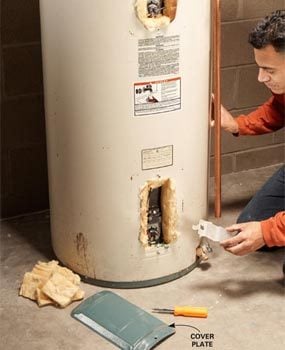
Remove the Cover Plates
- Turn off the power at the circuit billow.
- Remove the metal covers to expose the thermostats and elements.
- Pro tip: Make sure the power is off past touching the electrical connections with a noncontact voltage detector.
Step ii
Test the Wires
- Test the wires leading into the h2o heater.
- Notation: If the wires are covered by metal conduit, the tester won't read voltage. Y'all'll have to remove the metallic thermostat cover on the side of the water heater, pull out the insulation and concord the tester most the wires leading into the top of the high-temperature cutoff switch.
- Agree the tester against the metal water heater shell.
- Note: If the tester doesn't low-cal upwards, it's safe to examination the elements.
What'due south Inside a Water Heater and How It Works
Most residential electric water heaters have two heating elements: one well-nigh the top of the tank and one well-nigh the bottom. Power enters the peak and runs to the high-temperature cutoff switch, and then to the thermostats and elements. The tiptop and bottom elements are controlled past separate thermostats. When the water on the top of the tank is hot, the top element turns off and the lower one heats. The upper and lower heating elements never come on at the same time.

Step 3
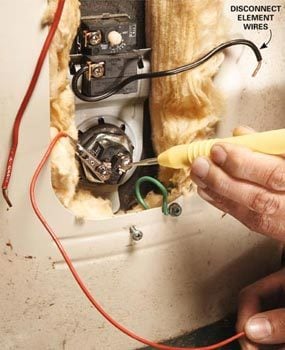
Exam Continuity for a Burned-Out Element
-
- Note: You'll need a continuity tester ($5 to $ten) for this footstep.
- Disconnect the wires from the terminal screws.
- Clip the alligator clench onto one of the element screws.
- Touch the other spiral with the tester probe.
- Note: If the tester doesn't calorie-free, replace the element.
Step iv
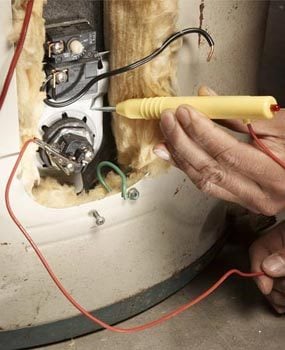
Test for a Short Excursion
- Clip the alligator clip to one of the chemical element screws.
- Touch the tester probe to the chemical element mounting bracket.
- Repeat on the other spiral.
- Annotation: If the tester light comes on either time, there's a brusk. Replace the element.
The Secret of the Reddish Button
Rarely, both elements will test okay, but you lot're notwithstanding not getting hot water. Endeavor pushing the button on the "high-temperature cutoff," located but to a higher place the upper thermostat. It may solve the problem, but if the trouble recurs, check your heating elements.
Footstep 5
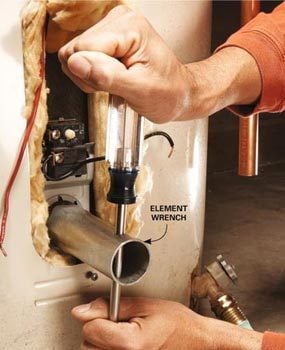
Remove the Bad Chemical element
- Close the cold-water inlet valve.
- Open the hot water faucet in the kitchen.
- Connect a garden hose to the drain valve and open up it to bleed the tank.
- Annotation: For thread-in–type elements like nosotros bear witness here, you lot'll need a water heater element wrench ($5 at dwelling centers and hardware stores).
- Unscrew the erstwhile chemical element using a heating element wrench.
- Pro tip: You lot'll demand a long, sturdy Phillips screwdriver to plow the socket. If it won't unscrew, employ a common cold chisel and hammer to loosen the threads.
Stride vi
Install the New Element
- Thread the new element into the water heater and tighten it with the heating element wrench.
- Reconnect the wires, making sure the connections are tight.
- Replace the insulation and metal covers.

Ownership Heating Elements
Replace your heating chemical element with one of the same wattage. If your old element isn't labeled with the wattage, refer to the nameplate on the water heater or your teaching manual, or search online using the model number from the nameplate.
Heating elements are held to the water heater either with a big thread and nut every bit shown here or by four bolts and nuts. About home centers stock the version we testify, just you lot can purchase an adapter kit if yous're replacing the 4-bolt version.
Simple U-shape elements are the cheapest. More than expensive depression-density elements are unremarkably folded back. These provide the aforementioned amount of heat but spread out over a larger surface area, which lowers the surface temperature, making them less prone to mineral buildup.
If your one-time element was caked with minerals, supervene upon it with a low-density element for more efficient operation and longer life.
Originally Published: November 27, 2022

How To Repair Hot Water Heaters,
Source: https://www.familyhandyman.com/project/diy-hot-water-heater-repair/
Posted by: carsonhable1998.blogspot.com
0 Response to "How To Repair Hot Water Heaters"
Post a Comment